Committees/Sport commitee/Rugby/About Underwater Rugby/11.09.08_davrell_is it a goal
01.01.1970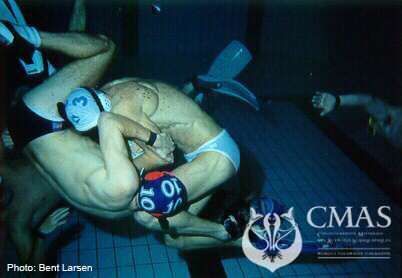
 photo_Suzette Střvring_1.jpg photo_Suzette Střvring_1.jpg |
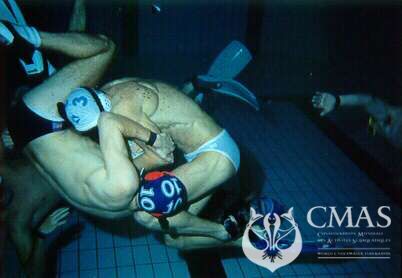
| Is the goalkeeper in the picture above in violation of any rule? |
“We have to be sure when awarding a penalty shot, for at the top level the better team often only wins by a single goal,” says Janne Lindell, one of 10 referees selected to work the upcoming World Championships in Helsinki, Finland.
 photo_Suzette Střvring_1.jpg photo_Suzette Střvring_1.jpg |
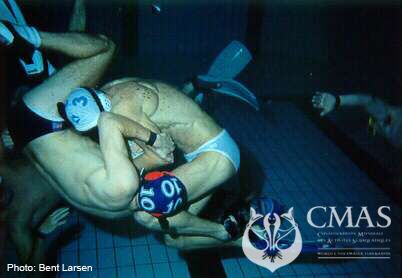
| One of the biggest challenges for a referee is to determine whether a goal was scored when there are several players in front of the basket in a tight game, says International referee Janne Lindell. |
“Sometimes we are unlucky enough to have our view of the goal blocked off and that is the toughest call for a referee in my opinion,” says Lindell.
The advantage rule
Another critical judgement call for referees is the application of the so-called advantage rule.
“If an infraction by the defending team is not a flagrant personal foul that calls for a penalty shot or expulsion, an experienced referee may allow play to continue,” says Lindell, “because the awarding of a free ball may allow the defenders to recover from a bad situation.”
The advantage rule also helps to preserve the flow of play, something that both teams generally appreciate. Referees should sign advantage but since play is not stopped by the buzzer these calls may go completely unnoticed. In Lindell’s view not all players fully understand the rule and can be irritated when an infraction is not called.
“If a player comes to ask that situation where the advantage rule came into play I will explain it more detail,” he adds.
Two referees underwater
 photo_Suzette Střvring copy.jpg photo_Suzette Střvring copy.jpg |
| The player in white has an illegal grip on the blue goalkeeper's snorkel. |
“It is common that if referee misses a foul that he or she only sees the foul in revenge that follows, but that’s why there will be two of us in Helsinki.”
Lindell, who refereed the German women’s victory over Sweden in the finals at the last World Championships in 2007, does not consider working the women’s matches to be much different. “For the referee the pattern of fouls is the same, the only difference is that men’s play is much faster and the women have a slightly smaller ball,” he says.
Long experience as referee and player
All of the referees at the upcoming World Championships come from the Nordic countries or Germany, a reflection of the general shortage of international referees. Too few retiring players decide to continue the sport as referees, according to Lindell, who played the game himself between 1984 and 2005. He has one Silver medal and one Bronze from Finnish National Championships. He became a national referee in the late 90s and started his international umpiring career in 2005.
National and international rules can differ slightly. Finland, for example, allows one time out per team per period while international play permits just one time out per team over the entire game.
“At this level of play we referees are very similar in approach, though there are some who are more into the letter of the rules and some are more pragmatic,” he observes.
The physical challenge
 photo_Suzette Střvring copy.jpg photo_Suzette Střvring copy.jpg |
|
International referee |
“How much and when a referee eats is very individual thing, some eat little snacks between games some eat a normal lunch and dinner when they have longer breaks,” says Lindell, prefers pasta as the fuel of choice.
Rule changes
Shortly before a match the referee checks finger nails and equipment for sharp edges. Even at Championship level play players sometimes must hurry to tape their mask or cut their nails. There is some discussion about fins and suits now, according to Lindell.
“If there are any changes to relate, we will provide a collective briefing before the Championships begin,” he says.
Davrell Tien